


The purpose of the first part of the paper is to explore the ethical and religious significance of guest friendship and hospitality in the ancient Greek tradition. In contradistinction to the Hebrew tradition of the Old Testament, in which God manifests himself in the guise of three strangers, the gods tend to withdraw and become more and more distant in the Greek tradition, where they are most of [....]
Publicaciones

The Fall of the Tekton and the Rise of the Architect: On the Greek Origins of Architectural Craftsmanship
The origins of architectural craftsmanship in ancient Greece are to be found in the archaic arts of tectonics. The first Greek architects, appearing under that name around the 6th century BC, rose out of and based their work on this age-old tectonic tradition, which semantically undergoes a transformation during the time from Homer to Plato, the latter relegating the tektones to a lower rank in th [....]

The double nature of being human: Beyond animality and divinity
Since the ancient Greek tradition, the question of what it means to be human has most often been answered by defining humans with reference to animality or divinity. The paper will offer an alternative understanding of the meaning of human ʻnatureʼ by reinterpreting the ancient Greek philosophy of logos as a way towards self-knowledge, which human beings can approach and perhaps reach, not in idle [....]

The open and the global: Postmodernism and its legacy
If Jean-Francois Lyotard was right that postmodernism did not refer to a time after modernism, but rather to what was inherent in modernism from its beginning, then the only way to find out what follows upon postmodernism may be to ask what went on in it in the first place. In The Postmodern Condition Lyotard claimed that postmodernism was characterized by “incredulity toward metanarratives”, whic [....]

“A Statesman Should Know the Soul”. On Emotional Rationality in Friendship
In the Nicomachean Ethics Aristotle urges the statesman to study to soul. Yet, what insight into the human soul did he hold in store for the statesman? Aristotle tends to privilege rationality over the emotions, but he also expounds the need for emotions to guide reason in practical life. Drawing on the notion of friendship, the paper offers a critical reinterpretation of Aristotelian ethics and p [....]

The dynamics of play – back to the basics of playing
In his seminal work Homo Ludens the Dutch historian Johan Huizinga laid out the pieces for a theory of play rooted in anthropological and cultural analysis, but he did not gather the pieces into a systematic account of the dynamics of play. Starting out from Huizinga’s observations of a common pattern in how play is designated and expressed in different languages, the paper argues that we need a d [....]
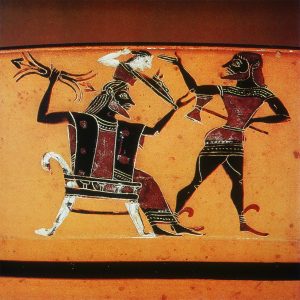
The Fall of the Tekton and the Rise of the Architect: On the Greek Origins of Architectural Craftsmanship
The origins of architectural craftsmanship in ancient Greece are to be found in the archaic arts of tectonics. The first Greek architects, appearing under that name around the 6th century BC, rose out of and based their work on this age-old tectonic tradition, which semantically undergoes a transformation during the time from Homer to Plato, the latter relegating the tektones to a lower rank in th [....]

Opening reason to transcendence: A philosophical grounding of architecture
The purpose of the present work is to ground architecture in a philosophical outlook which opens human beings to transcendence. Such an outlook is already present in the earliest tectonic tradition of architecture, the origins of which will be unearthed in the work. Yet, a broader philosophical investigation, which draws on anthropological, epistemological, ethical and theological traditions, is n [....]